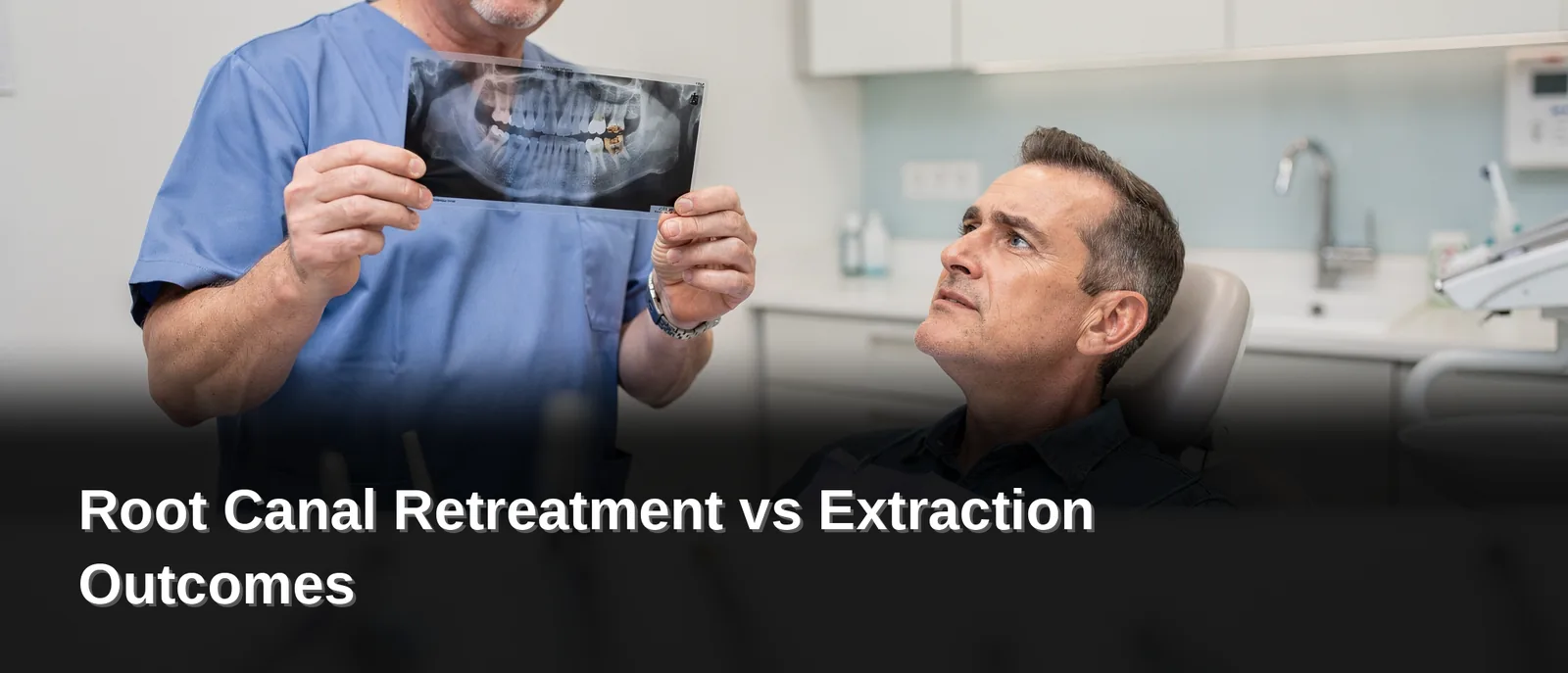
Retreatment success rates range from 78.8–87.5%, giving most patients a strong chance to save their natural tooth rather than move to extraction and implant placement. Retreatment preserves your bite and avoids a gap. Extraction remains the better option only when the tooth is too damaged or persistently infected.
Root canal retreatment saves your natural tooth in most cases, preserving your bite and avoiding an implant’s cost and healing time. Extraction becomes the better choice only when the tooth suffers structural damage or repeated infection. Retreatment addresses the root cause of failure, while extraction simply removes the problem, leaving a gap requiring replacement.
Key Takeaways
- Endodontic retreatment succeeds 78.8–87.5% of the time, preserving your natural tooth long-term.
- Natural teeth outperform implants in longevity and overall oral health outcomes consistently.
- Modern retreatment uses microscopes, CBCT imaging, and rubber dam isolation for superior results.
- Saving your natural tooth remains the preferred option when retreatment is clinically viable.
What Causes a Previously Treated Tooth to Fail?
Persistent bacteria hiding in tiny, overlooked canal branches cause most cases of a failed root canal. Missed anatomy, cracked restorations, and new decay under an old crown all give infection a fresh foothold. Left unaddressed, that infection spreads quietly around the root tip, often without pain until swelling or a dental abscess forces the issue.
Complex canal anatomy is a common culprit. Some teeth harbor extra canals or curved, narrow passages that standard treatment tools simply cannot reach without magnification. Anodyne Endodontics evaluates this anatomy using microscope-guided root canal therapy, giving a much clearer view of structures a prior treatment may have missed.
Diagnosing the real cause takes specialized training, not guesswork. An endodontist completes years of additional education focused entirely on what happens inside the tooth, which sharpens the ability to pinpoint exactly why healing stalled the first time. That depth of focus is why Anodyne Endodontics specializes in retreatment. Emergency endodontic care for patients throughout DuPage County, including anyone dealing with a tooth that never fully healed.
Why does a root canal fail years after treatment?
Fracture and reinfection rank among the leading late-stage causes. A tooth can develop a new crack. Bacteria can enter through a leaking crown margin long after the original procedure. Recurring pain, tenderness while chewing, or swelling near a previously treated tooth are signals worth acting on quickly.
Is retreatment always possible after failure?
Not always — the decision depends on how much healthy tooth structure remains. Patients weighing endodontic retreatment vs extraction need an honest evaluation of the tooth’s condition. Infection history before choosing a path forward.
How High Is the Retreatment Success Rate?
Success rates for root canal retreatment land between a notable share. A notable share, depending on the study population and the technology used. A published comparison of endodontic and implant outcomes found overall success rates of 86.02% for primary root canal treatment, 78.2% for nonsurgical retreatment, and 63.4% for surgical retreatment, against 90.9% for dental implants. Numbers like these explain why so many patients weigh options carefully before deciding what to do with a failed root canal.
Older figures don’t tell the whole story, though. For decades, studies lumped together cases treated with outdated hand instruments and no magnification alongside cases treated under current standards, blurring the real picture of retreatment success. In April 2024, a research team from UCSF and the University of Toronto addressed that gap directly, publishing a review in the Journal of Endodontics restricted to studies using modern imaging, rotary instrumentation, and magnification. Their tighter dataset produced a cleaner, more current success estimate than the older pooled numbers ever could.
Does modern technology change retreatment odds?
Yes. Magnification and imaging let your specialist see canal anatomy that older equipment missed entirely, raising the odds of clearing infection completely. Anodyne Endodontics performs focused, microscope-guided treatment for exactly this reason. The same standard associated with the higher retreatment success rates seen in current research.
When you’re weighing endodontic retreatment vs extraction, these figures matter less as a single verdict and more as a starting point. Your tooth’s specific condition still drives the final recommendation.
Retreatment or Extraction: Which Preserves More?
Saving your natural tooth through root canal retreatment preserves more of your original anatomy, bite function, and jawbone structure than extraction does. In most situations, retreatment beats extraction as the option worth pursuing first. Extraction still has its place. Only when your tooth is too damaged to restore or keeps developing new infection despite prior treatment.
Think about what you actually keep with each path. Retreatment lets you hold onto your natural bite, your original tooth, and the bone that supports it. You also skip the gap that extraction leaves behind, along with the follow-up decisions that gap usually forces.
Is retreatment always better than extraction?
Not always, but it is the better starting point for most patients. Your tooth’s structural integrity matters most here. If enough healthy tooth remains and reinfection hasn’t become a recurring pattern, retreatment gives you a real shot at keeping what nature gave you.
What does Anodyne Endodontics prioritize when you’re facing a failed root canal?
Anodyne Endodontics leads with a preservation-first philosophy for every patient dealing with a failed root canal. Treatment stays calm, precise, and focused on saving your natural tooth whenever that path remains viable. Minimally invasive techniques and biocompatible materials support that goal, alongside education about how your oral health connects to your broader well-being.
When you weigh endodontic retreatment vs extraction, consider what each choice costs you long-term:
- Retreatment — preserves natural bite, avoids a gap, maintains jawbone stimulation
- Extraction — removes ongoing infection risk but requires a replacement plan afterward
Your specific tooth, your symptoms, and your long-term goals ultimately shape the right decision for you.
What Makes Anodyne’s Approach to Retreatment Different?
Board-certified endodontist Dr. Zainab Aziz leads every root canal retreatment case at Anodyne Endodontics in Bloomingdale, IL. That distinction matters more than it might sound. A failed root canal involves reopening a tooth that has already been through one procedure, often with hardened filling material and altered canal anatomy. Work that rewards specialized training, not general dental experience.
Dr. Aziz earned her Doctorate of Dental Surgery from Marquette University and completed advanced endodontic training at Boston University, focusing on microsurgery and complex retreatment cases. You benefit directly from that training when your case involves calcified canals, missed anatomy, or persistent infection around a previous filling.
Why does a small practice matter for retreatment care?
Anodyne Endodontics operates with a five-person team, deliberately kept small. You see fewer unfamiliar faces and get closer oversight from the same clinician who reviewed your imaging and treatment plan from day one.
A smaller team also means fewer handoffs between your consultation, procedure, and follow-up visits.
What materials does Anodyne use during retreatment?
Anodyne Endodontics commits to the least toxic materials available when rebuilding a retreated tooth. This choice supports the practice’s broader view that healing the tooth should not come at the expense of your overall health.
Weighing endodontic retreatment vs extraction requires more than statistics — it requires a clinician who treats your case individually. Consider what you get with this approach:
- Specialty-trained oversight on every retreatment case
- Consistent care from a compact, familiar team
- Biocompatible material choices aimed at supporting healing, not just sealing a canal
What Should You Do Next?
A persistent ache in a previously treated tooth deserves a prompt evaluation, not a guessing game. Schedule a consultation at the Bloomingdale office of Anodyne Endodontics to get a clear diagnosis before symptoms worsen. Delaying that step risks losing the tooth entirely, along with the time and expense already invested in your original treatment.
Anodyne Endodontics serves Bloomingdale and the surrounding DuPage County communities — Wheaton, Glen Ellyn, Carol Stream, and Bartlett included — with microscope-guided care built specifically for cases like yours. That precision matters when you’re weighing root canal retreatment against removal.
How do you decide between retreatment and extraction?
Your decision comes down to the tooth’s remaining structure, the pattern of infection, and your long-term goals for your bite. Retreatment preserves your natural tooth and avoids a gap in your smile. Extraction stops ongoing infection immediately and can open the door to replacement options such as implants or bridges, when the tooth is too compromised to save.
What happens during the evaluation visit?
Expect a conversation that treats your failed root canal as more than an isolated problem. The practice’s mission centers on treating the tooth, mind, and body as one connected system, which shapes how your options get explained.
Before your visit, note down:
- When symptoms started and how they’ve changed
- Any swelling, pain with chewing, or lingering sensitivity
- Questions about endodontic retreatment vs extraction you want answered directly
FAQ
What is the success rate of root canal retreatment?
Retreatment success rates range from 78.8–87.5%, giving most patients a strong chance to save their natural tooth. A published comparison found nonsurgical retreatment succeeds 78.2% of the time, compared to 90.9% for dental implants.
When is extraction the better choice over retreatment?
Extraction remains the better option only when the tooth is too damaged or persistently infected. The decision depends on how much healthy tooth structure remains after evaluating the tooth’s condition and infection history.
What causes a previously treated tooth to fail?
Persistent bacteria hiding in overlooked canal branches cause most failures, often due to missed anatomy, cracked restorations, or new decay under an old crown. Fracture and reinfection through a leaking crown margin also rank among leading late-stage causes.
Conclusion
In closing, endodontic retreatment represents a scientifically supported pathway to preserve your natural tooth and avoid the complications associated with extraction. By choosing advanced root canal therapy over tooth removal, you invest in long-term oral health, maintain your natural bite mechanics, and preserve the integrity of your jawbone. The evidence is clear: saving your tooth through retreatment delivers superior outcomes for your overall well-being and quality of life.